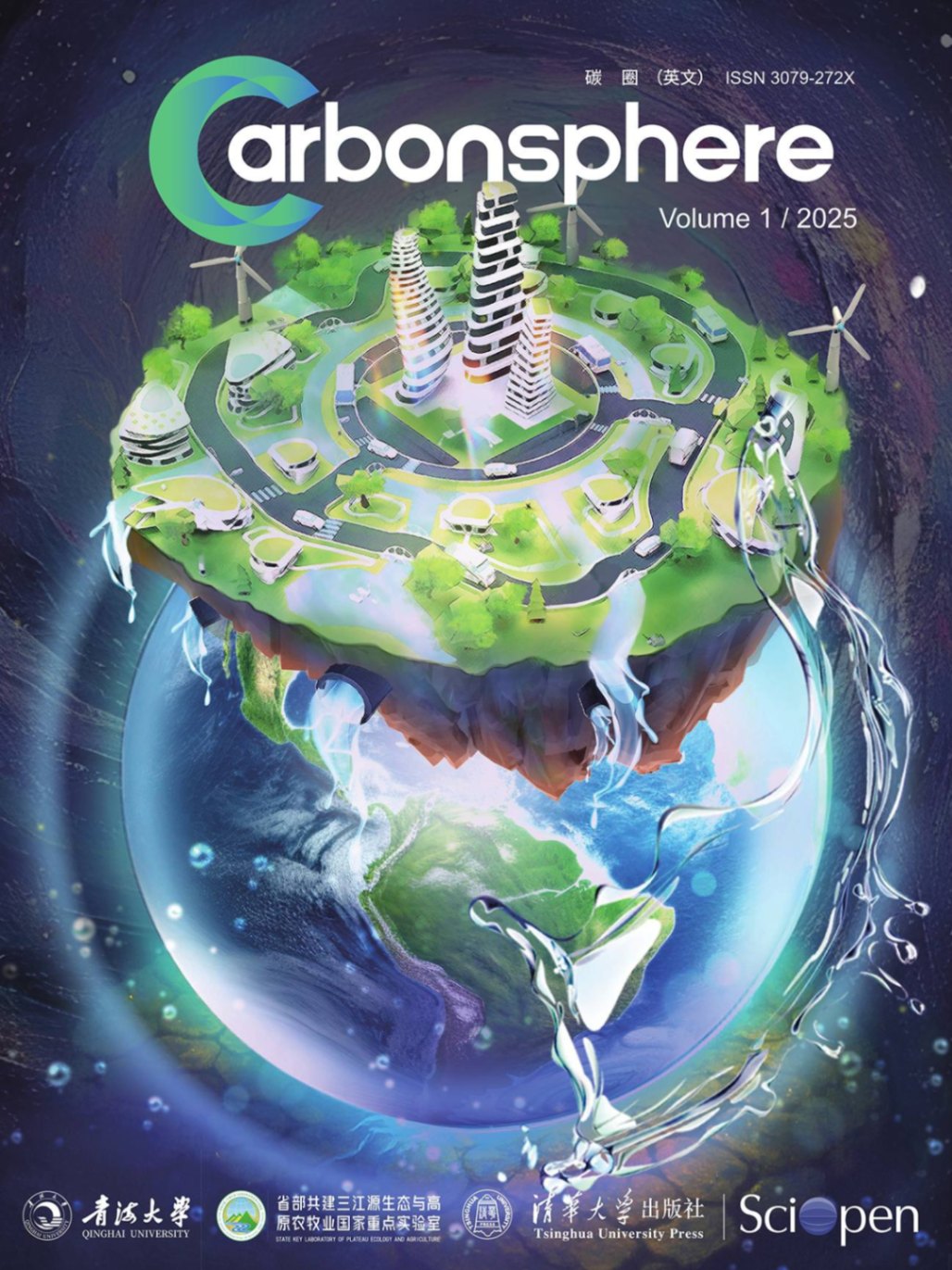
Carbon is the basic element of life. Carbon links life's inner metabolism to the earth system processes, from photosynthesis, respiration, and microbial pathways at the microscopic level to primary production, decomposition, and soil–ocean carbon storage at the landscape and planetary scales. Carbonsphere launches to illuminate and steward this micro-to-macro continuum, connecting the atmosphere, biosphere, hydrosphere, cryosphere, lithosphere, and anthroposphere through advances that move from mechanisms to models, from prototypes to policy, and from scientific discovery to societal decision-making. We aim to build a shared platform across science and engineering, and the natural sciences and the humanities/social sciences, to co-create evidence and solutions for a just net-zero future.
Carbonsphere is explicitly interdisciplinary, open, and impact oriented. We welcome work that crosses disciplinary boundaries—linking chemistry, biology, ecology, geoscience, materials and process engineering, computer and data science/AI, economics, law, design, ethics, and the humanities—to explain and govern carbon from system perspectives. We seek studies that close loops beyond scales (molecule-to-material, cell-to-organism, plot-to-landscape-to-planet, model-to-market) and methods (theory and laboratory experiments, field observations and remote sensing, mechanistic and statistical modeling, digital twins and decision support). We value both fundamental advances and implementation-inspired, translational research that charts credible pathways from discovery to deployment—bench-to-field-to-policy-to-practice.
All submissions should uphold rigorous peer review, transparent reporting, and reproducibility. We especially encourage cross-disciplinary teams, interoperable datasets and software, and manuscripts that integrate the natural sciences with the social sciences and humanities to address equity, ethics, and public meaning in the carbon transition.
From Earth Systems to Human Systems. We encourage studies that trace processes and teleconnections across the atmosphere, land, ocean, cryosphere, and lithosphere into human systems; quantify cross-layer fluxes, feedbacks, and time lags; and identify thresholds, tipping elements, and leverage points for Earth and climate mitigation, adaptation, and resilience.
From Science to Engineering to Policy. We seek contributions that link mechanistic insight and experiments to practical technologies and infrastructures and that couple validated prototypes and pilots with analyses of governance, regulation, markets and finance to advance scalable system solutions and their integration.
From Natural Sciences to Social Sciences & Humanities. We invite integrative analyses that combine physical science and engineering with social aspects to design transitions that are feasible, financeable, and fair.
Together, these pillars define Carbonsphere's editorial stance: an interdisciplinary, open, impact-oriented forum where coupled-sphere science and cross-domain scholarship co-create evidence and solutions for a just net-zero future.
Carbonsphere publishes Original Research, Review Article, Perspectives, Short Communication, Letter to the Editor (Correspondence). We also prioritize Data & Software Articles, Design & Prototypes, Methods, and Bench-to-Policy contributions that translate scientific insight into operational guidance (standards, protocols, metrics). We especially welcome cross-sphere evidence chains that integrate observation, modeling, and implementation.
We are committed to high standards of peer review, transparent reporting, and encouragement of data/code sharing to maximize reuse and trust. Carbonsphere is designed as an open, collaborative commons that connects researchers, engineers, practitioners, and policymakers—amplifying scholarly excellence and real-world impact.
Launching Carbonsphere is a deliberate step to meet the demands of our time and to support global climate and sustainability strategies. We recognize that founding a new journal is challenging, yet with the collective support of authors, reviewers, editors, and partners across disciplines—from natural and social sciences to engineering and the humanities—we are confident that Carbonsphere will grow into a flagship forum for coupled carbon science, policy, and technology. Together, we will advance rigorous knowledge and deployable solutions worldwide. May this new journal thrive, and may we all work together for a new land of interdisciplinary frontier.